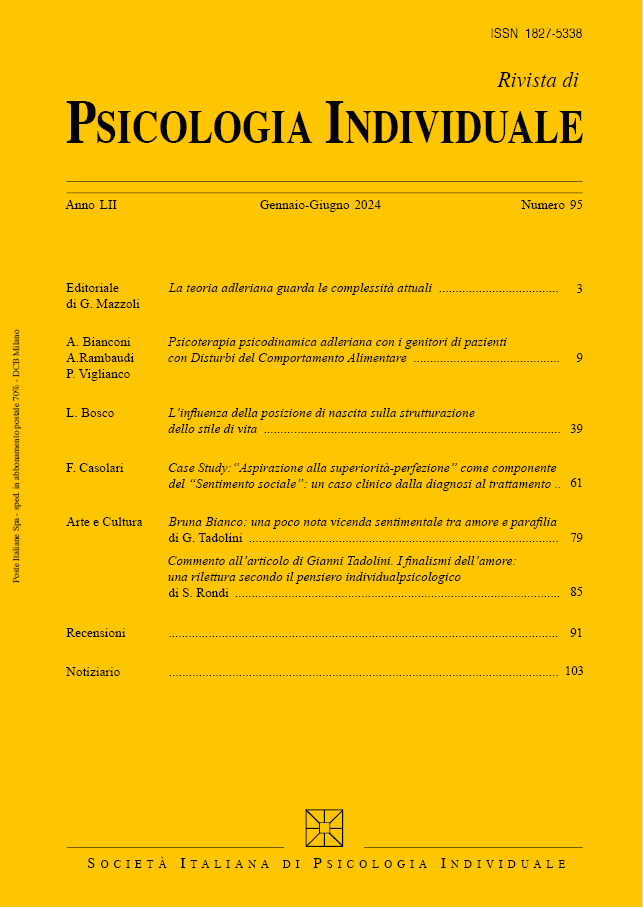
The Meaning of the Symptom: an Adlerian Approach to Psychodiagnosis
Keywords:
symptom, style of life, final goal, depression, fictions, psychodiagnosisAbstract
In accordance with Alfred Adler's theoretical framework, the objective of this paper is to demonstrate, through the examination of several clinical cases, that symptoms represent not merely pathological manifestations, but rather, they are indicative of unconscious objectives that are intricately interwoven with the individual's tendency to perceive reality in a specific manner. This perspective stands in contrast to conventional psychiatric nosology, which characteristically categorises psychopathological conditions without acknowledging the subjective significance of the symptoms and consequently their symbolic function. Furthermore, the concepts of normality and neurosis frequently exhibit partial overlap, and even in more severe cases, intermediate or transitional forms are often evident. This complicates the establishment of clear diagnostic boundaries. Furthermore, the analogy between individuals with the same disorder or similar symptoms is often minimal. A study of three cases demonstrated how depression can be understood in different ways depending on the individual's schema of apperception. In summary, the aim of this
analysis is to demonstrate that an Adlerian perspective can offer a deep interpretation of the symptom as a functional expression of unconscious dynamics, rather than a simple diagnostic datum. This paradigm shift has significant implications for clinical intervention and patient comprehension.