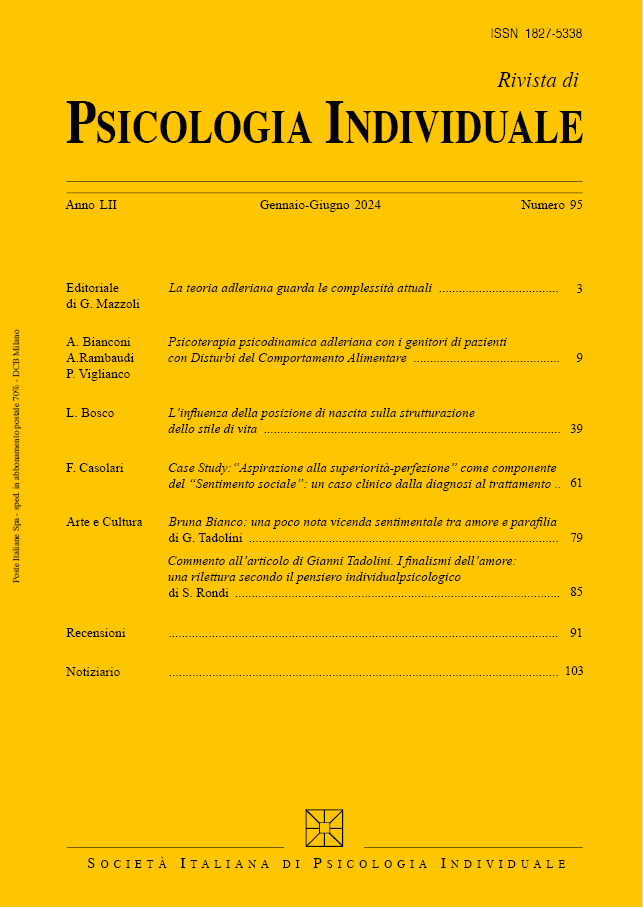
Considerations on Adlerian Metapsychology
Keywords:
finalism, causalism, individual psychology, lifestyleAbstract
This work analyzes the dichotomy between Freudian causality and Adlerian finalism, highlighting how this contrast, often presented in a simplified manner, risks generating theoretical ambiguities and methodological distortions in psychotherapeutic practice. The author proposes a more integrated view, in which finalism does not exclude reference to causality, but broadens its perspective, directing observation not only towards the origins of the symptom, but also towards its unconscious goals and functions. It is highlighted how Adler, while supporting an environmentalist and behaviorist view, developed an approach based on individual lifestyle, conceived as a dynamic synthesis of compensations, early experiences, and adaptation strategies. From this perspective, personality analysis must consider both historical factors and projections into the future, valuing the subjective meaning attributed to events. The Adlerian methodology, based on the recollection of early memories and the observation of the patient's relational patterns, is therefore a form of phenomenological interpretation. Far from rigidly applying a pre-established model, the therapist must adapt their language and strategies to the patient's level of emotional and cognitive maturity. The risk of arbitrarily attributing finalistic meanings to resistance dynamics is also emphasized, where these could instead reflect unprocessed processes or unresolved countertransference. Finally, the need for Adlerian psychotherapists to be open to other interpretative tools consistent with the principles of Individual Psychology is affirmed, avoiding ideological closures and favoring clinical effectiveness and the recognition of subjective singularities